
Alfrun Rose’s Dead Air has arrived at Greenwich Theatre following a successful Edinburgh Fringe run. The new London play explores grief, AI resurrection tools and digital afterlife technology through a powerful one-woman performance.
Losing a relative is painful, but in the digital era, an alternate solution has emerged. In recent years, AI resurrection tools have become grief companions. Through images and voice memos, they revive the dead. But are the replicas at all similar to the deceased?
On at Greenwich Theatre until May 16, Dead Air follows a fictionalised version of Alfrun Rose as she comes to terms with the loss of her father through an AI deathbot.
The tragicomedy is a modern take on grief, furthering the conversation surrounding resurrection tools and how depending on them might not be a viable long-term solution. The solo performance also inspects the cost of keeping the dead alive through digital means, as subscription limitations get in the way. Here is our Dead Air review, the new London play exploring AI as a grief companion.
Dead Air at Greenwich Theatre Explores Grief in the Age of AI

Dead Air is a dark comedy about the struggles of letting go of someone you love. Alfie is grief-stricken after her father’s passing, and she resorts to an AI resurrection tool for comfort. Although her mother moved on with a new flame (John, who also happens to be her late father’s best friend), Alfie has not yet recovered.
Every time she phones AiR’s customer service line, she renews her subscription to keep in touch with him. Yet, as one would imagine, the technological version will never fully live up to who her father truly was.
The play taps into the illusion of being connected with the dead and how exploitative resurrection tools may be for those recovering from grief. A Hamlet reimagining set in the digital era, Dead Air begs audiences to silence their phones and be guided by their imagination as Alfrun Rose delivers a piercing solo act.
The play blends comedy and tragedy in equal measure and ironically abstains from AI use. It shows how Alfie’s internal guilt for not being by her father’s side on his deathbed continues to affect her long after he is gone. Communicating with a virtual ghost provides her with temporary solace. Yet, resorting to a subscription plan with limited usage makes her realise that the investment will never amount to healing. That part she has to do on her own.
Why Did Alfrun Rose Write a Play Exploring AI as a Grief Companion?
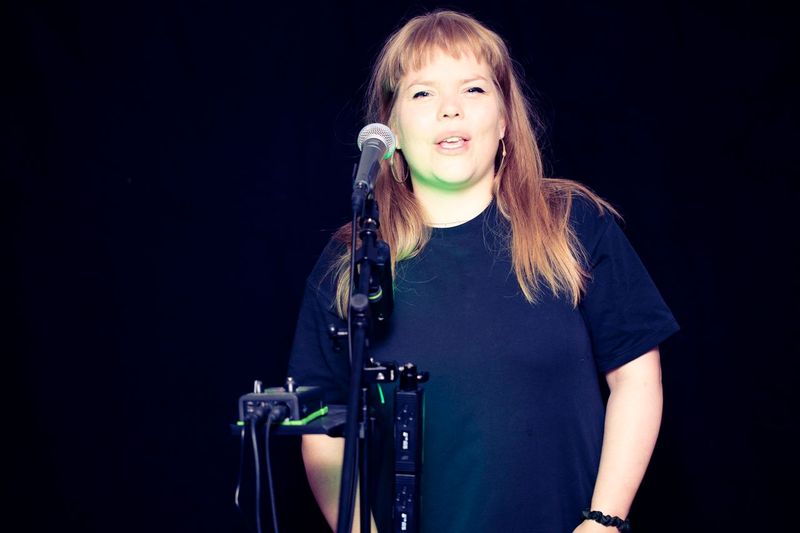
Alfrun Rose might’ve starred in Netflix’s Eurovision Song Contest: The Story of Fire Saga and in Fantastic Beasts: The Crimes of Grindelwald, but she’s known for her work on stage. The Icelandic actor and writer is based in the UK, and Dead Air is her latest theatrical effort.
According to Rose, the play had been ruminating in her mind for a year prior to her writing it. Despite its theme being topical, Dead Air was directly inspired by her own experience navigating the loss of her father, Icelandic music legend Gis Von Ice.
The playwright discussed the making of Dead Air in the following statement. “After the death of my dad, a beloved, behind-the-scenes guy in the music industry, I found myself grasping for traces of him: photos, recordings, fragments of his voice… This isn’t a play about my dad, although I borrow a couple of his jokes. It is a modern ghost story about the glitchy, glorious ways we keep the dead alive.”
Through her Substack, Rose shared that the AI component to her play about grief stemmed from a documentary she watched. She was initially horrified by the rise of AI resurrection tools. Still, upon further reflection, Rose understood the urge to have conversations with the deceased about the present. Dead Air explores how resurrecting someone that you used to know based on data is tricky.
After all, you don’t know which version of that person you might get based on text messages, videos, and images. Alfie fine-tunes the AI version of her father to meet her own needs. In doing so, she is actively changing who he is. Although the playwright used AI resurrection tools as inspiration, she never considered adopting this practice herself.
The Rise of AI Resurrection Tools
In Rose’s perception, passing ownership of a late relative’s personal data is a breach of privacy and could affect one’s mental health. Her concern about this digital band-aid for grief is understandable. What seemed like a possibility in the realm of science fiction is now a real-life technological advancement.
AI resurrection tools became a viral trend on social media back in 2024, reviving dead celebrities with Sora 2. More advancements led to chatbots like Replika literally replicating people’s text messaging styles and AI companies like StoryFiles allowing for the dead to speak at their own memorial service.
In 2024, James Vlahos shared with the BBC that he created an AI chatbot to soothe his grief experience after his father died of cancer. Although the tool allowed for certain memories to remain alive, he shared that it didn’t mitigate the pain brought by loss.
The legalities of AI usage remain a grey area in the UK, with no AI-specific regulations in place. AI regulation is currently dealt with through existing legal frameworks. Dead Air might not fully explore the uncertainty of AI resurrection tools, but it does imagine what it could mean for someone undergoing grief to use them.
Dead Air Review: Alfrun Rose Is a Stellar Solo Act
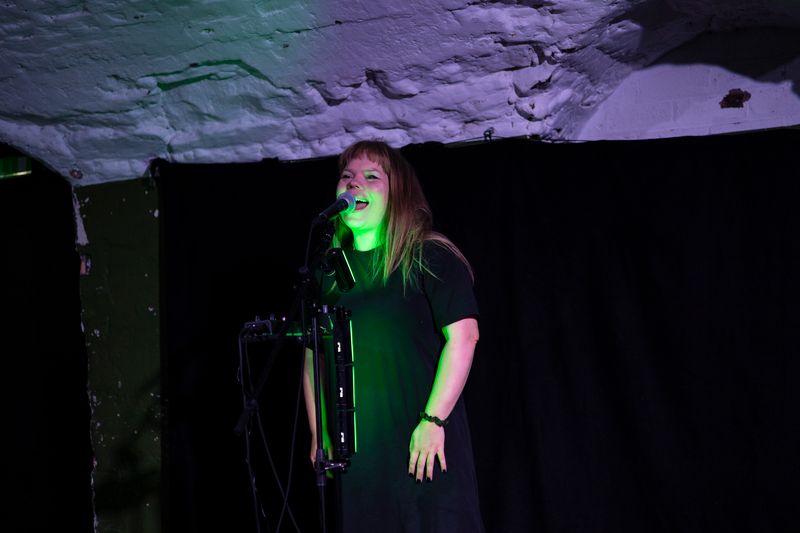
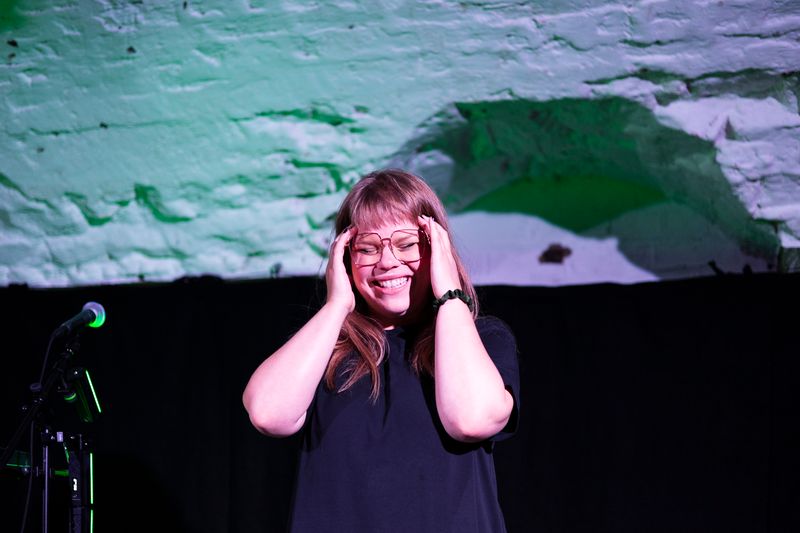
The Women’s Journal was in attendance at Dead Air‘s opening night for review. In an intimate setting and with minimal props in sight, Alfrun Rose began her solo act, ironically singing “Stayin’ Alive”. The song symbolised AiR’s track of choice for customers on hold, waiting to upgrade their subscription to their AI deathbot.
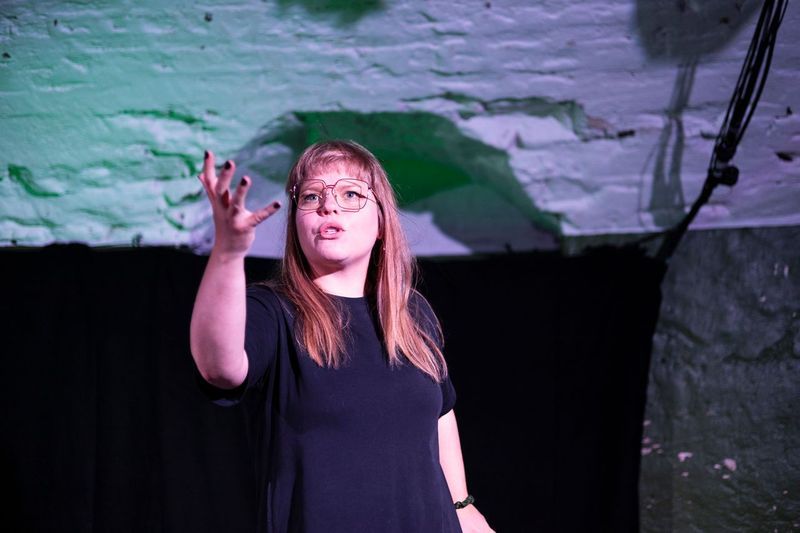
In the context of the play, whenever Alfie puts on her glasses, she can envision her father standing next to her and engage in conversation with him. She can confide in him about her boyfriend’s infidelity and her failed attempts at conceiving. Alfie can also talk about how upsetting it’s been to see her mother ignite a relationship with her father’s best friend. In her words, “It didn’t take long for Mum to Marie Kondo you.” Everyone seems to be moving on, but she is still drowning in sorrow.
Rose alternates from playing Alfie to starring as her father, her mother, her mother’s new boyfriend, and an AI customer service representative. Each character has a distinct way of communicating, and she captures those nuances throughout the play.
Dead Air is particularly poignant when it explores the AI iteration of Alfie’s father and how his jokes and temperament change the more carefully curated he becomes. Instead of feeling comfort in his presence, the protagonist navigates a mixture of emotions. She is glad she has her loved one to talk to but continues to express her dissatisfaction with the AI deathbot.
A line that encapsulates the play’s message is “It’s human nature to hold on.” After all, the reasoning for Alfie’s continued investment in the AI deathbot despite its faults is her urge for companionship. Dead Air uses AI as a starting point for a bigger conversation about connection and belonging.
Alfie’s grief journey is filled with ups and downs, but she learns to rely on her own memories (and dreams) of her father, as opposed to the digital version of him. The stage production is a worthwhile reminder that living through the pain is part of the process.
Dead Air FAQs
What Is Dead Air About?
Dead Air follows a fictionalised version of Alfrun Rose as she copes with the death of her father through an AI resurrection tool. The one-woman play explores grief, memory and digital afterlife technology.
Who Stars In Dead Air?
Alfrun Rose plays multiple characters in this one-woman stage production.
Does Dead Air Use AI?
The play does not use AI but rather has Alfrun Rose using a sound board to alter her voice when playing the AI version of her father and the AI customer service assistant.
Where Can I See Dead Air?
Catch performances of Dead Air at the Greenwich Theatre in London. Book tickets here.
How Long Will the Play Be in London For?
The play will be on from 13 to 16 May at the Greenwich Theatre before Alfrun Rose continues her tour in Denmark later this month.
What Does Alfrun Rose Have Coming Up Next?
The actress and playwright is currently working on her next stage production, Dream House. Although the play is a work in progress, audiences who stick around after Dead Air will see her perform some scenes from Dream House. It follows two siblings with opposing tastes who bond while sharing ownership of their childhood home. The play draws references from Changing Rooms and The Haunting of Hill House, and also taps into the climate crisis.